
Shortly after finishing the Appalachian Trail, I found myself broke and living back in Columbia, South Carolina, with my mom, sister, and stepfather. I thought it would be a good idea to pursue a job related to my biology degree, which I had earned prior to leaving for the Appalachian Trail. While searching for a role in my field, I worked at a restaurant bar.
Finally, I landed a job as a lab technician in a laboratory, primarily in the endocrinology department. It didn’t take long to discover that a life of fluorescent lights, lab coats, latex gloves, and pipetting spit and serum was not who I was or wanted to be professionally.
It was then that I decided to hike another long-distance trail. I set my eyes on the Pacific Crest Trail. Over 2,600 miles long, it stretches from the California–Mexico border to the Canada–Washington border through California, Oregon, and Washington. Little did I know I would cross another iconic bridge on foot through my passion for long-distance backpacking. I found that bridge at the border of Oregon and Washington: the Bridge of the Gods.

A Crossing at the Heart of the Pacific Crest Trail
For Pacific Crest Trail hikers, the Bridge of the Gods is more than just a crossing—it’s a milestone. The bridge carries hikers across the Columbia River between Cascade Locks, Oregon, and Washington State, marking the transition from Oregon into the final stretch of the trail through Washington. It is also the lowest elevation point on the entire Pacific Crest Trail, making it a memorable waypoint for northbound hikers pushing toward Canada. (Wikipedia)
After months in the wilderness, stepping onto a steel bridge spanning one of the great rivers of the American West feels surreal. The Columbia River Gorge opens dramatically around you, with cliffs rising on both sides and wind sweeping through the valley.
But the structure beneath your feet is not just a scenic crossing—it is an impressive piece of early twentieth-century engineering.
Engineering the Modern Bridge of the Gods
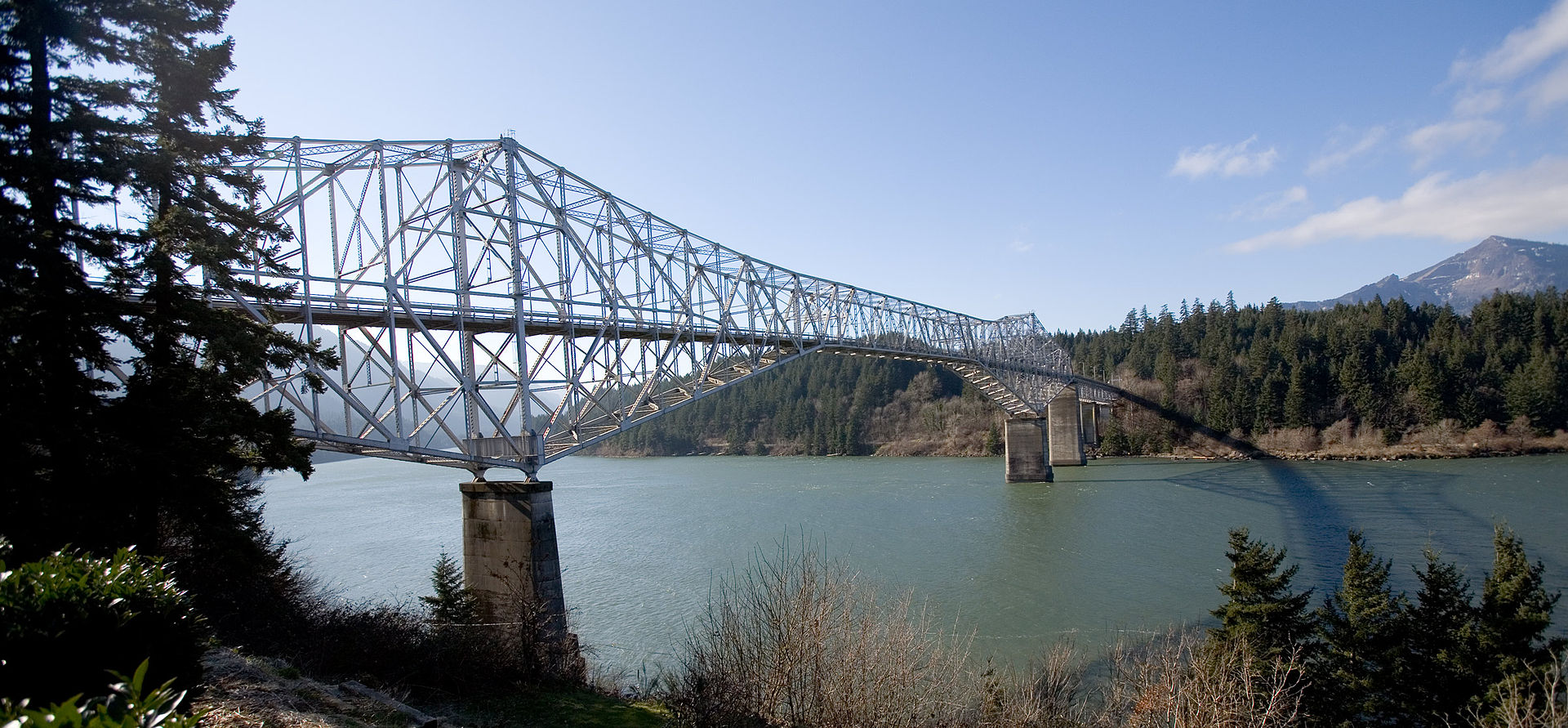
The modern bridge was completed in 1926 by the Wauna Toll Bridge Company as a steel cantilever through-truss bridge spanning the Columbia River. (Wikipedia)
Its design reflects the engineering approaches commonly used for long river crossings in the early 1900s. Cantilever truss bridges allow long spans to be constructed outward from piers without the need for temporary supports in the water—an advantage when working over deep or fast-moving rivers.
Key characteristics of the bridge include:
- Main cantilever span of approximately 706 feet
- Overall bridge length of about 1,856 feet
- Width of roughly 35 feet
- Steel truss construction designed to support roadway traffic and pedestrian crossings (portofcascadelocks.gov)
Originally shorter and lower, the bridge underwent major modification when the nearby Bonneville Dam was constructed in the late 1930s. The rising reservoir behind the dam required the bridge to be raised by about 44 feet and lengthened, ensuring sufficient clearance for river navigation and the new water levels. (portofcascadelocks.gov)
Today the bridge remains a functioning toll bridge operated by the Port of Cascade Locks, serving both local traffic and the thousands of Pacific Crest Trail hikers who cross it each year.
A Name Rooted in Geology and Legend
While the modern steel bridge dates to the 1920s, the name “Bridge of the Gods” is far older.
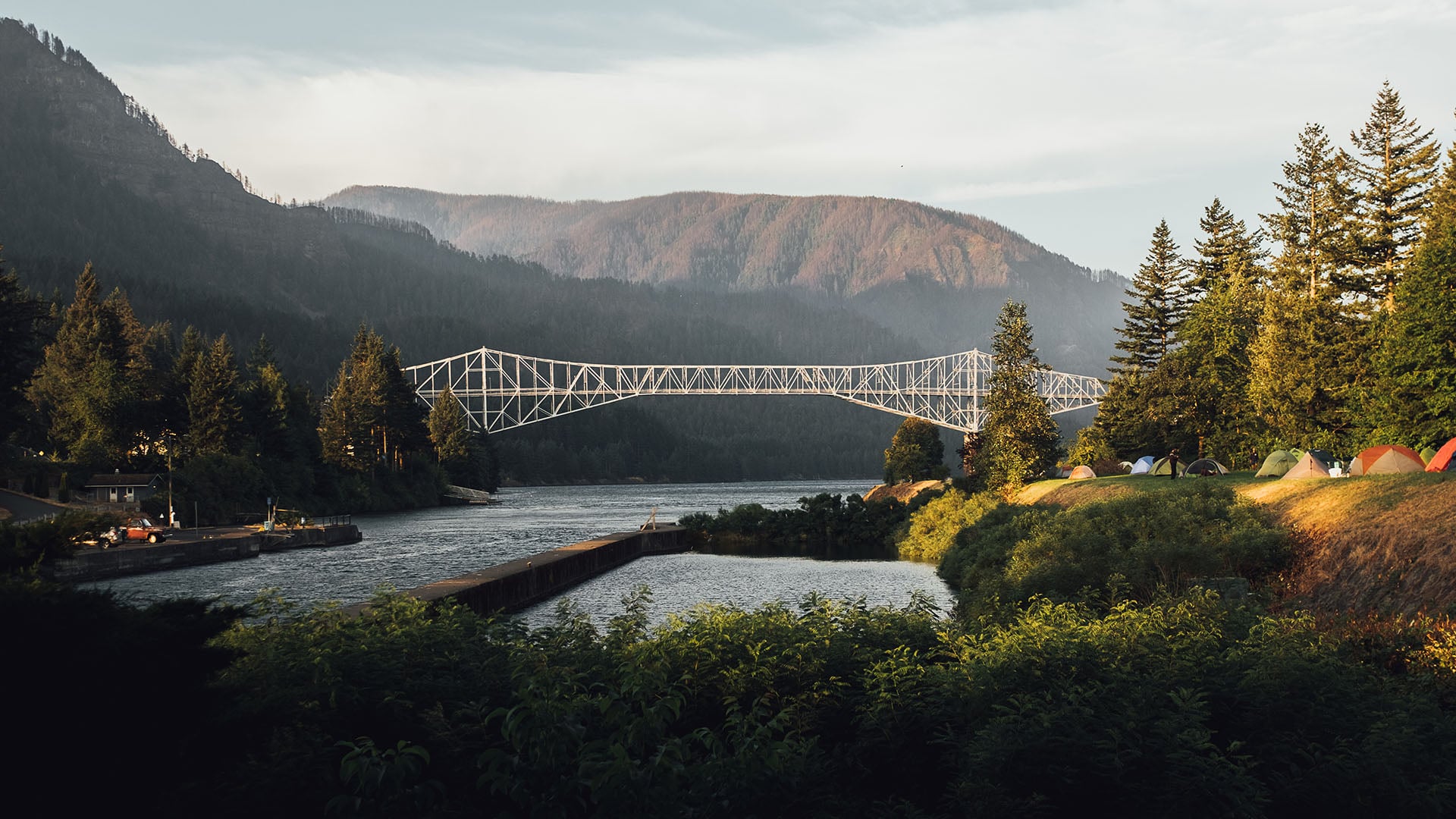
The name originates from a massive geologic event known as the Bonneville Landslide, which occurred centuries ago when part of Table Mountain collapsed into the Columbia River. The landslide created a natural dam that temporarily blocked the river and formed a natural land bridge across the gorge. (Oregon Encyclopedia)
For a time, people could reportedly cross the Columbia River on this natural formation “without getting their feet wet.” Eventually the river breached the blockage, carving through the debris and forming powerful rapids that defined the gorge for centuries.
Local Native American traditions preserved stories of this dramatic event, describing a great natural bridge created by powerful forces—hence the name Bridge of the Gods. (Oregon Encyclopedia)
The modern steel bridge simply inherited the legendary name of the ancient natural crossing.
From the Trail to the Bridge
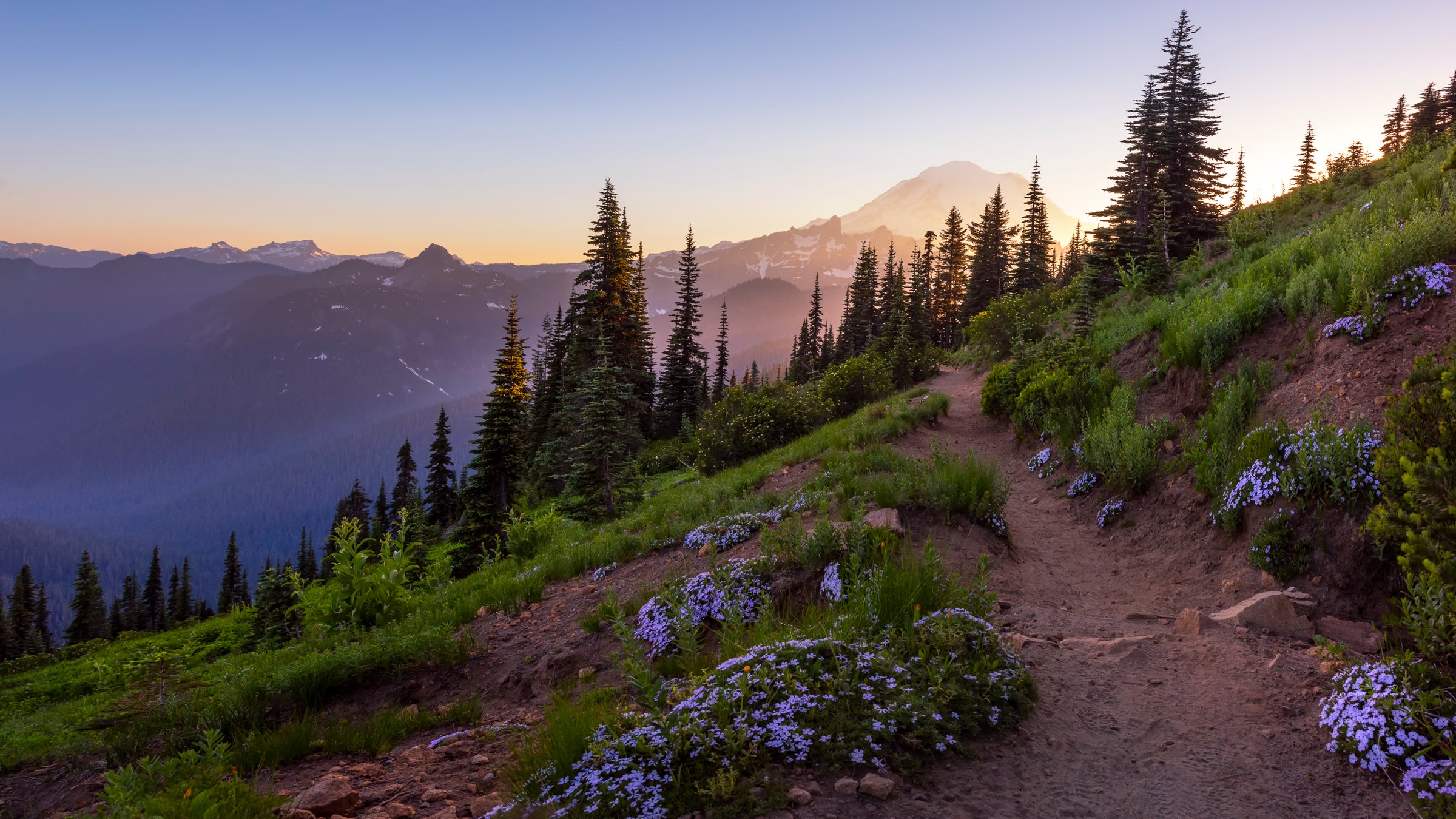
When I crossed the Bridge of the Gods on the Pacific Crest Trail, I had no idea how much the experience would echo my earlier Appalachian Trail journey. On that trail, crossing the Hudson River on the Bear Mountain Bridge gave me my first real appreciation for the scale and beauty of bridge construction.
Standing on the steel deck high above the Columbia River, I felt that same sense of curiosity again.
The open-grid steel beneath your feet lets you see the water far below, and the wind rushing through the gorge reminds you just how powerful this landscape is. For hikers, the bridge represents progress—the moment when Oregon is behind you and Washington lies ahead.
For me, it was something more.
Moments like that—standing on a structure that connects landscapes, communities, and history—reinforced a growing fascination with bridges and the people who build them.
Long before I knew it, those experiences on the trail were quietly shaping the direction of my career.