
Choosing between small vs large construction companies is one of the most important decisions construction professionals make. Company size can significantly influence your responsibilities, career development, learning opportunities, and long-term success. While both types of employers offer rewarding experiences, the right choice depends on your career goals and preferred work environment.
Understanding the Differences Between Small and Large Construction Firms
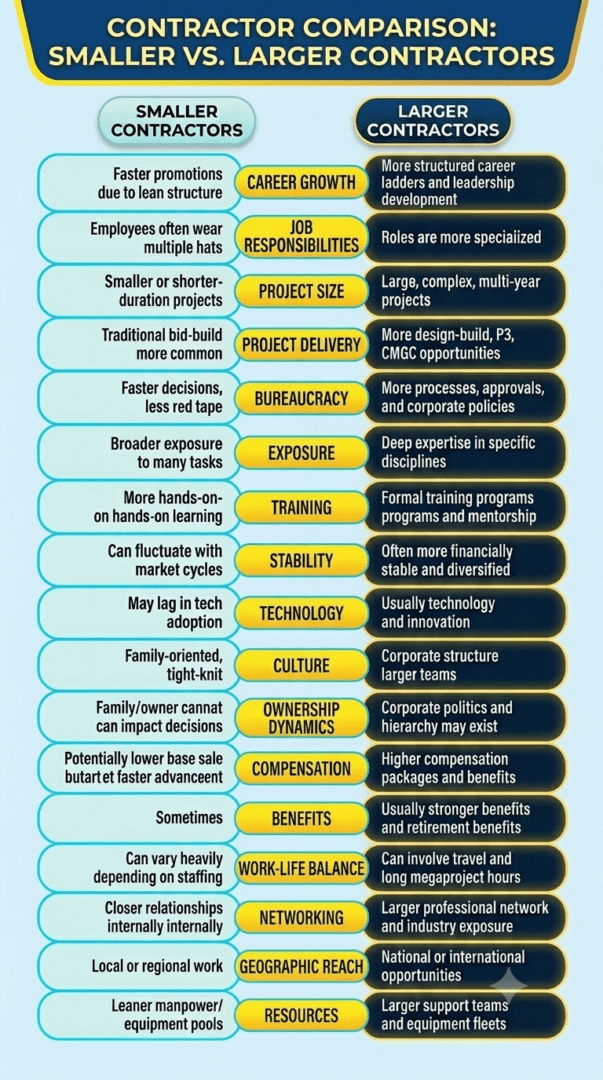
When comparing small vs large construction companies, it is essential to understand how company structure affects your day-to-day responsibilities. Smaller contractors typically operate with lean teams where employees handle multiple functions. Larger organizations usually have specialized departments and more defined career paths.
Neither option is inherently better. Instead, each provides unique opportunities that appeal to different personalities and career ambitions.
Benefits of Working for Small Construction Companies
One of the biggest advantages of small vs large construction companies is the broad exposure available at smaller firms. Employees often gain hands-on experience in estimating, project management, scheduling, field operations, safety, and client relations.
More Responsibilities and Faster Learning
Because smaller contractors have fewer layers of management, employees frequently receive meaningful responsibilities earlier in their careers. This accelerated learning environment allows construction professionals to develop a comprehensive understanding of project execution from start to finish.
Greater Visibility and Career Advancement
Smaller companies also provide increased visibility with owners and senior leaders. High-performing employees may advance more quickly because organizational structures are less complex and decision-making processes are often faster.
However, smaller firms may also have limited training budgets, fewer resources, and heavier workloads due to lean staffing.
Advantages of Large Construction Companies
When evaluating small vs large construction companies, larger contractors often stand out because of the scale and complexity of their projects. These organizations commonly manage major infrastructure, industrial, commercial, and heavy civil construction projects that require sophisticated systems and extensive resources.
Exposure to Large-Scale Construction Projects
Working for a large contractor can provide opportunities to participate in high-profile projects while learning advanced construction methodologies. Many large organizations invest heavily in leadership development, safety initiatives, project controls, and technology solutions.
Specialized Career Paths and Technical Expertise
Another advantage of small vs large construction companies is the opportunity for specialization. Employees at larger firms can focus on disciplines such as estimating, field engineering, scheduling, quality control, project management, or safety management.
Many large contractors also self-perform multiple scopes of work, exposing employees to earthwork, concrete, utilities, structures, paving, equipment operations, and other technically challenging construction activities.
Challenges of Small and Large Construction Employers
Every construction company comes with challenges. Smaller organizations may have fewer resources and limited training programs. Career advancement can sometimes depend heavily on company ownership structures and leadership dynamics.
Conversely, larger organizations may involve additional bureaucracy and administrative processes. Decision-making often requires multiple approvals, and some employees may feel like a small part of a much larger organization. Career progression can also be more competitive and structured.
Company Culture and Work Environment Matter
A major consideration when choosing between small vs large construction companies is company culture. Smaller contractors often create close-knit environments where employees work directly with owners and senior leadership teams. These relationships can foster collaboration and provide increased visibility.
Larger organizations may offer broader professional networks, mentorship opportunities, and the ability to transfer between projects, departments, or geographic regions. However, personal relationships may not feel as close because of the organization’s size.
Choosing the Right Construction Company for Your Career
The decision between small vs large construction companies ultimately depends on your individual career goals. If you enjoy broad exposure, entrepreneurial environments, and taking on responsibilities quickly, a smaller contractor may be an excellent fit.
If you prefer working on major projects, utilizing advanced systems, and developing specialized expertise, a larger construction company may better align with your aspirations.
Success in the construction industry is not determined solely by company size. Professionals who continually learn, build strong relationships, and seek growth opportunities can build rewarding careers in both environments.