
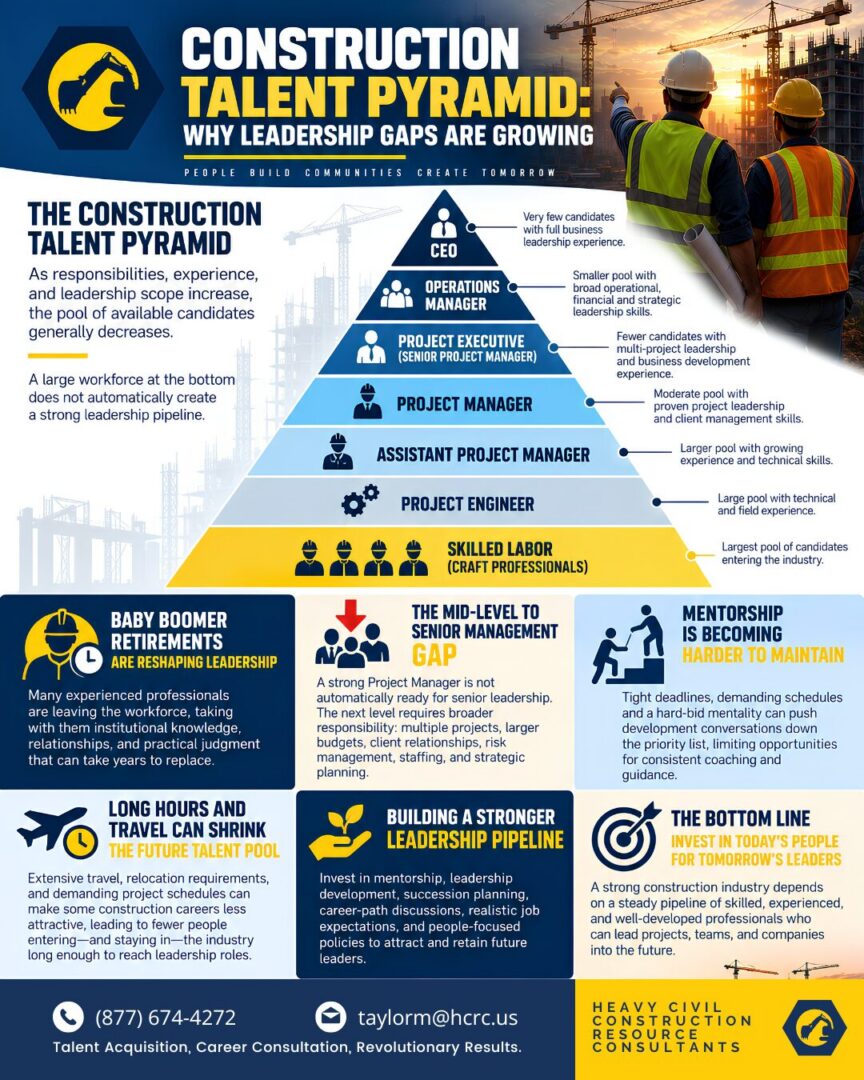
The construction talent pyramid shows a simple but important reality: the number of available candidates generally decreases as responsibilities, experience, and leadership scope increase. At the broad base are skilled labor professionals, followed by Project Engineers, Assistant Project Managers, Project Managers, Project Executives or Senior Project Managers, Operations Managers, and finally CEOs at the top.
That structure matters because a large workforce at the bottom does not automatically create a strong leadership pipeline. Each promotion step requires experience, technical judgment, project leadership, client management, financial responsibility, and people-management skills. As candidates move upward, the pool becomes narrower.
Understanding the Construction Talent Pyramid
Think of the construction talent pyramid as a funnel. Skilled labor represents the largest pool. Above it are Project Engineers, who can develop into Assistant Project Managers and eventually Project Managers. From there, fewer professionals progress into Project Executive or Senior Project Manager roles, followed by Operations Manager and CEO positions.
The pyramid becomes especially narrow between middle management and senior leadership. Companies may have plenty of employees capable of performing project-level work, but far fewer candidates prepared to lead multiple projects, manage operations, develop teams, and make business-level decisions.
Baby Boomer Retirements Are Reshaping Construction Leadership
One major pressure on the construction talent pyramid is the retirement of experienced Baby Boomers. Many professionals who built decades of field, project, and operational knowledge are leaving the workforce.
When those experienced leaders exit, companies lose more than job titles. They lose institutional knowledge, relationships, estimating and project lessons, leadership habits, and practical judgment that can take years to develop.
That creates urgency for contractors to identify and develop the next generation before senior leaders leave.
The Mid-Level to Senior Management Gap
The gap in the construction talent pyramid is particularly visible between Project Manager and senior-level leadership. A strong Project Manager is not automatically ready to become an Operations Manager or Project Executive.
The next level often requires broader responsibility: multiple projects, larger budgets, client relationships, business development, risk management, staffing, and strategic planning. Without deliberate development, professionals can remain successful at their current level without gaining the experience required for the next one.
This is one reason succession planning should begin well before a leadership position becomes vacant.
Why Mentorship Is Becoming Harder to Maintain
Mentorship is another critical part of the construction talent pyramid, but the industry’s operating environment can make it difficult to sustain.
Tight deadlines, demanding schedules, project emergencies, and a hard-bid mentality can push development conversations down the priority list. Experienced leaders may want to mentor emerging managers but simply do not have enough time to provide consistent coaching.
When mentorship becomes informal or sporadic, employees can miss opportunities to learn how senior leaders approach contracts, clients, negotiations, risk, staffing, and difficult project decisions.
Long Hours and Travel Can Shrink the Future Talent Pool
The construction talent pyramid also depends on a steady flow of people entering the industry and staying long enough to develop. Long working hours, extensive travel, relocation requirements, and demanding project schedules can make some construction careers less attractive to potential entrants.
If fewer people enter—and fewer remain long enough to reach management—the top of the pyramid eventually becomes harder to fill.
This is especially important for contractors thinking about executive succession. The executive candidate shortage is not created at the executive level alone. It can begin years earlier when the industry loses potential Project Engineers, Assistant Project Managers, and Project Managers from the pipeline.
Building a Stronger Leadership Pipeline
Strengthening the construction talent pyramid requires a long-term approach. Contractors can invest in structured mentorship, leadership development, succession planning, career-path discussions, and realistic job expectations.
Companies can also examine whether flexibility, scheduling, travel expectations, compensation, and career progression are helping them attract and retain people long enough to become future leaders.
The goal is not simply to fill today’s openings. It is to build a pipeline capable of producing tomorrow’s project and executive leaders.